HTML Encoder/Decoder
Convert between plain text and HTML entities with multiple encoding options
HTML Encoder
Convert text to HTML entities
Understanding HTML Encoding & Decoding
HTML encoding (or "escaping") converts special characters (like <, >, &) into HTML entity representations (e.g., <, &, ©). Decoding reverses this. It's crucial for web security (preventing XSS), correct content display, and data integrity in HTML.
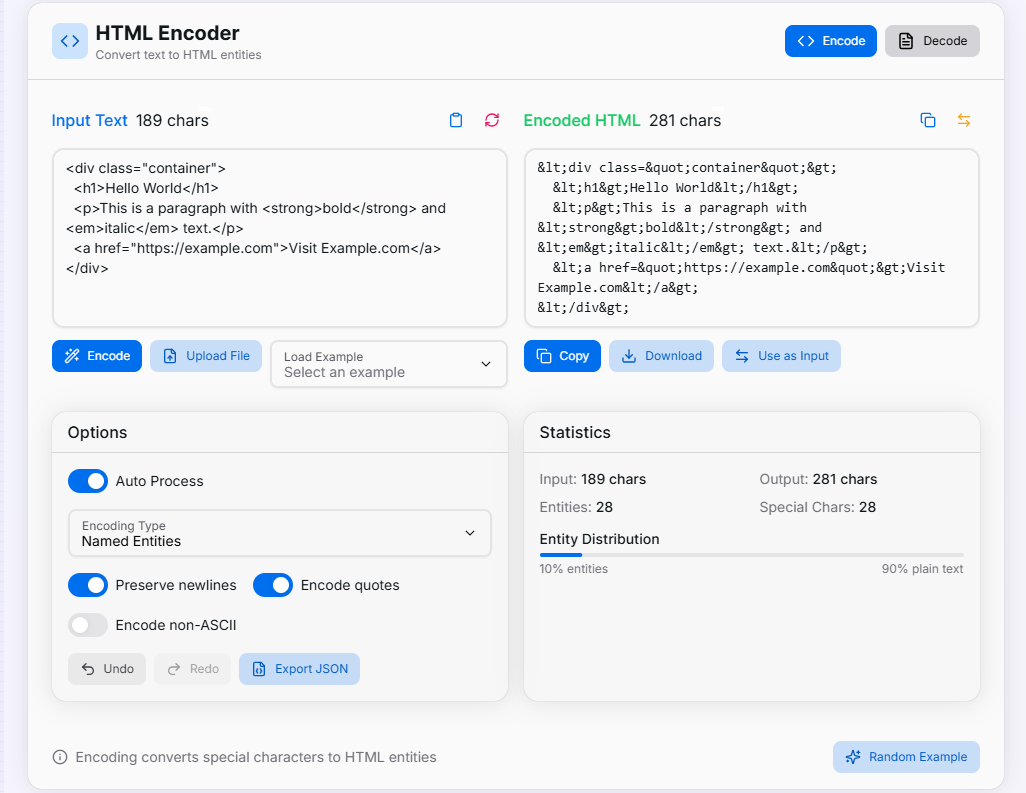
How to Use the HTML Encoder/Decoder?
- 1Input your text:
Paste or type the text or HTML code you want to process into the input area.
- 2Select the operation mode:
Choose "Encode" to convert characters into HTML entities, or "Decode" to convert entities back into characters.
- 3Configure processing options:Encoding Type:Select from Named, Decimal, or Hexadecimal entities.Character Options:Choose how to handle newlines, quotes, and non-ASCII characters.
- 4Process the text:
Click the "Encode" or "Decode" button. For real-time results, enable the "Auto Process" option.
- 5View the result:
The converted text will appear in the output area, ready for you to review.
- 6Copy or download:
Use the provided buttons to copy the output to your clipboard or download it as a text file.
Supported Encoding Entity Types
Named Entities
Most readable, e.g., < for <, & for &.
Covers common special characters.
Decimal Entities
Numeric representation, e.g., < for <.
Can represent any Unicode character.
Hexadecimal Entities
Hex numeric representation, e.g., < for <.
Alternative numeric, also for any Unicode char.
Key Features
Common Use Cases
Preventing XSS
Safely display user content by encoding it, blocking malicious scripts.
Displaying Code
Show HTML/XML snippets on a webpage without browser interpretation.
HTML Attributes
Embed text with special characters safely within tag attributes.
Internationalization
Ensure non-ASCII characters display correctly across systems.
Data Integrity
Store or transmit data with special characters without corruption.
Learning Tool
Understand HTML entity representations of characters.
Tips & Considerations
- Choosing Entity Types: Named entities (e.g.,
<) are readable but limited. Numeric entities (Decimal:<, Hex:<) cover all characters. - Non-ASCII Characters: Use "Encode non-ASCII" for accented letters or symbols outside standard ASCII for maximum compatibility.
- Security First: Always encode untrusted data before rendering in HTML. Ensure decoded entities are from a trustworthy source.
- Context Matters: Encoding needs vary (HTML content,
tags, URLs, attributes). This tool focuses on HTML content.
This HTML Encoder/Decoder tool simplifies managing special characters in web content, helping you build more secure and robust web applications.
Related Tools
JWT Encoder/Decoder
Securely encode and decode JSON Web Tokens (JWT) for authentication and data exchange.
Base64 Encoder/Decoder
Encode and decode data using Base64 encoding with advanced features.
URL Encoder/Decoder
Encode or decode URLs, Professional URL processing with RFC 3986 compliance and deep analysis
HTML Encoder&Decoder
Convert between plain text and HTML entities with multiple encoding options.
HTML Formatter
Clean up, standardize, and optimize your HTML code with advanced formatting options.
HTML Minifier
Compress and optimize your HTML code with advanced minification options.